South West Region UCU Rotating Header Image

HE and FE Strike Action 3rd December

On 3rd December UCU members in both HE (Higher Education) Universities and FE (Further Education) Colleges will be on strike together after being offered a derisory below the rate of inflation “pay rise”. Even this low offer in both cases comes with “strings” which will make further inroads into the established collective bargaining framework.

For FE this is their first day of strike action. HE establishments have already seen one day of strike action (31st October) and have been working to contract since then. In this action HE are striking with their sister unions in universities Unison and Unite.

Keep an eye on this blog page for news of pickets and rallies near you. Please support any you can.

South West Rallies

Bristol – There will be a rally in Bristol at 1-2pm on College Green. City of Bristol College, University of Bristol and UWE (University of the West of England). UCU, Unison and Unite strikers and their supporters will rally here after their pickets at the respective three institutions. Speakers so far are Dominique Lauterberg (UCU NEC), Harriet Bradley (UCU NEC), Nigel Costley, Secretary South West TUC and Mike Hines, Unison, National Service Group Rep.

South West Pickets

NB – Information posted here is to enable those who wish to visit pickets or support in other ways to do so. ALL colleges and ALL universities are out. For the South West Region this means eight universities and over 40 colleges. If there is a college near you you wish to support who is not listed here please email dotoole (at) ucu.org.uk and I will try to put you in touch with that college. (Other things may take priority)

Bath Spa University – Main Gate, Bath Spa University, Newton Park, Newton St Loe, BA2 9BN

Bournemouth & Poole College – North Rd (Bournemouth & Poole College) site, Poole, BH14 0LS

Bristol University – Senate House, Tyndall Avenue, Bristol BS8 1TH

City of Bristol College

Ashley Down Centre – Ashley Down Road, Bristol. BS7 9BU

College Green Centre – St George’s Road, Bristol. BS1 5UA (from 7.30am)

Soundwell Centre – St Stephen’s Rd, Bristol, Avon BS16 4RL

South Bristol Skills Academy  – The Boulevard, Hengrove Promenade, Bristol, BS14 0DB

Parkway Advanced Engineering Centre – New Road, Stoke Gifford, Bristol BS34 8SF

Cornwall College

Camborne Campus – Trevenson Road, Redruth, Cornwall TR15 3RD. Picket will meet in Halfords car cark opposite the college at 8.00 AM.

Saltash – Church Road, Saltash. PL12 4AE. from 8:00am

Exeter College Main Site:  Hele Road, Exeter, EX4 4JS

Falmouth University – Penryn Campus, Falmouth University, Penryn, TR10 9EZ

Petroc College (North Devon) – North Devon Campus, Petroc, Old Sticklepath Hill, Barnstaple, Devon, EX31 2BQ

Plymouth University: 08:00 AM onwards in front of the Portland Square Building. Plymouth University, Drake Circus, Plymouth. PL4 8AA

University of Bath – from 7:30am

Junction of Claverton Hill/Convocation Ave

Junction of Quarry Rd/North Rd

2 South pedestrian entrance.

University of Exeter

The Queen’s Drive  and Prince of Wales Road – , Exeter. EX4 4QJ

St Lukes campus – Heavitree Road, Exeter. EX1 2LU

Barrack Road – Barrack Rd, Exeter, Devon EX2 5DW

University of St Mark and St John (Marjon)  – Main Entrance, Derriford Road, Plymouth PL6 8BH

UWE (University of the West of England)

Frenchay Campus – Main gate at  Coldharbour Lane, Bristol BS16 1QY

Truro College – College Road, Truro, Cornwall -TR1 3XX from 8.20am

Supporting the action

http://www.upsu.com/news/article/7137/UPSU-supports-Strike-Action/

…UPSU’s Student Parliament, as the recognised student voice of UPSU, voted to support Strike Action being carried out by University staff who are members of recognised trade unions at Plymouth University.


Solidarity

Higher Education institutions across the region will “walk out” out on Thursday 31 October as part of a national, rolling programme  of industrial action by three unions (UCU, Unison and Unite) in support of pay.

Fellow trade unionist will realise that OUR struggle is YOUR struggle. Please send messages of support to exeter@ucu.org.uk

Best wishes and solidarity for today’s strike and your dispute in general from the South West Region of the NUT.   We all have a common interest in our current public sector disputes and in education it is necessary to make it clear that the austerity and privatisation being promoted by this Government is not in the interests of either school students or those involved in Further and Higher education.

 Andy Woolley, Regional Secretary, NUT South West

Dear Colleagues,

There comes a time when you run out of options, when no one will listen, when no one will take any notice of your concerns.   That time for us was punctuated by a series of national rolling strikes, the last ones being on 17th  October which saw over 3,000 teachers on the streets of Bristol alone.  Your support for us on that day was very much appreciated and was greeted by cheers from those in the hall.  For you the time to stand up and be counted is now.  It is not something any of us take lightly and NASUWT SW  Region send best wishes and solidarity to you now in your time of action.  Brothers and sisters, we stand with you.

 In Solidarity

Ian Phillips, Chair of SW Regional Committee NASUWT
Kathy Wallis, Vice Chair of SW Regional Committee NASUWT

HE Pay Dispute 2013 – FAQ

Strike FAQs and guidelines on picketing

If you have a question that is not answered here, please email your branch secretary or campaigns@ucu.org.uk . We will do our best to reply to you and/or update this FAQ.

1. What am I expected to do during a strike?
2. Do I have to tell my employer that I am taking strike action?
3 . What about my students?
4. Am I breaking my contract by taking strike action?
5. How much money will I lose?
6. What if I am part time?
7. How will it affect my pension?
8. What is the law on picketing?
9. I am not a UCU member. Can I take part in the strike?
10. I am a Research Fellow fully funded by external bodies but I don’t want to cross the picket line.(HE)
11. I am a clinician and a UCU member, and I have clinical commitments on strike day. What can I do? (HE)

1. What am I expected to do during a strike?

Your union will only take strike action once every other avenue of influence has been exhausted and when your branch officers think there is no other way to make members’ views clear. It is a very serious sanction and that’s why we ask that every member observes the strike. Every member who does not observe the strike is directly undermining the union’s bargaining power and making it harder for the union to protect all its members.

When we call a strike we ask that members do not come into work and do not reschedule their classes. The best possible thing you can do is contact your local rep and volunteer to help out on the picket lines. It isn’t illegal, it isn’t dangerous and it can be fun.

2. Do I have to tell my employer that I am taking strike action?

In order to fulfil legal requirements, employers have been provided with statistical information about UCU members taking industrial action, but not individual names. You are under no obligation to inform management in advance as to whether you will be taking part in strike action or action short of a strike. However, if your manager asks you after the strike whether you took action, you should answer truthfully.

3 . What about my students?

We are a union of professionals and we know that our members don’t like taking any action that affects students. It is the same for many public services. However, when we take action, we are generally making a case for greater investment in or defence of the quality of the service we provide. In the case of job cuts, for example, we argue that our students will be hurt far more by management’s actions than by our own. Observing the strike is defending the interests of staff and students alike. Undermining the strike might feel like the right thing in the short term but will only serve to encourage management and we will all suffer more in the longer term.

Formally, it is management’s responsibility to explain to students if classes are to be cancelled on strike days. However, you may wish to talk to your students before the strikes explaining why the union is taking this action. We will have a leaflet available explaining to students why we feel it is necessary to take action. Ask your rep for copies.

4. Am I breaking my contract by taking strike action?

All effective industrial action may be a breach of your contract of employment. But because UCU has carried out a statutory ballot and the action has been formally called, the law protects workers from dismissal whilst taking part in lawful industrial action or at any time within 12 weeks of the start of the action and, depending on the circumstances, dismissal may also be unfair if it takes place later.

5. How much money will I lose?

You should expect to have a day’s salary deducted for taking part in the strike. Some institutions state that 1/260th of your annual salary will be deducted for each day of action. Any loss greater than this can be challenged by the union.

6. What if I am part time?

UCU believe that any deduction must be pro-rata for part time staff. The deduction must only be for your contracted hours. Please contact UCU for support in challenging any greater loss.

7. How will it affect my pension?

In previous one-day strikes it has been the experience of UCU that most university employers do not withhold superannuation contributions and therefore participation in strike action has not generally affected pensions. Also, institutions that do choose to withhold contributions often make provision for members to make up pension and AVC deficits from their pay. If you are concerned about any effect, contact Geraldine Egan at UCU (gegan@ucu.org.uk).

8. What is the law on picketing?

Peaceful picketing is entirely legal. Picketing should be carried out at or near an entrance or exit from a site at which the pickets work. When others who are not in dispute come into work or use these entrances or exits, pickets must not interfere with them.

The legal categories of people permitted to picket are:

  • UCU members in dispute
  • UCU officials and NEC members supporting members in dispute, providing they are accompanying union members who work at the location.
  •  Visitors to the picket are entirely lawful but should not form an official part of the pickets and should not, for example, be given armbands.
  • Further detailed advice on the picket lines should be issued separately.

9. I am not a UCU member. Can I take part in the strike?

We would like everyone to respect the picket lines and not go into work, but if you are not a UCU member we will not be able to support you if the college decides to take disciplinary action against you. However, it is your general support that counts—if you can get permission from your line manager to take annual leave or work from home, this would be support.

10. I am a Research Fellow fully funded by external bodies but I don’t want to cross the picket line.(HE)

If you are a UCU member please join the picket line! If you are not, try to arrange to work from home.

11. I am a clinician and a UCU member, and I have clinical commitments on strike day. What can I do? (HE)

We fully understand that clinical staff including medics and psychologists have professional commitments to provide clinical cover. Clinicians are advised not to withdraw from any commitment to direct clinical care and activities in support of such. Any clinician concerned about the definition of these terms is advised to contact their own professional defence organisation, and ask them to contact the relevant professional body (eg the GMC) on their behalf. The UCU will therefore respect this. A clinician who intends to strike should be aware that this will only count as lawful action as part of the UCU strike and if s/he is a UCU member.

Susan Banducci – The Selection of Women as Political Candidates

Susan Banducci Professor in Politics College of Social Sciences and International Studies University of Exeter


UCU South West Retired Members’ Branch invites you to come and hear Susan Banducci, Professor in Politics College of Social Sciences and International Studies University of Exeter.  http://socialsciences.exeter.ac.uk/politics/staff/banducci/

Her talk is on the selection of women as political candidates. We are relatively informal. You can ask questions as she goes along and there will be time for discussion at the end. She will speak for 30-45 minutes and stay for the buffet lunch with us.

12.00 a.m. – 1.00 p.m. Tuesday 19th November 2013.
Venue: UCU Office.  Labour Party Rooms,  26b Clifton Hill, Exeter EX1 2DJ

A buffet lunch will be provided if you let us know a week in advance.

To book your place email ucu.swest@gmail.com

Gordon Bartlett – RIP

It is with deep sadness that we need to let you know that Gordon Bartlett passed away peacefully at home on the 2nd September surrounded by his family and is now at rest. Gordon was a highly principled person and an active participant in UCU. He was an elected union secretary for City College, Plymouth from UCU’s inception and before that an active participant in NATFHE. An effective case worker, conscientious and stalwart in defending individual member’s grievances and concerns he was a regular attendee at local meetings, a good listener as well as being excellent at debating. As secretary, he kept the minutes of meetings as well as representing the union when the Chair was unable to do so. He responded positively to every campaign and he would always join the picket line, if we were called out on strike. He was a great believer in trade unionism, in defending individual rights and freedoms, in fighting for a fairer and more equitable society as well as securing a decent standard of living for all, in a safer and more humane world.

We have lost a friend, a colleague, a member, an activist and a man of stature. It is rare that a person can combine their ideals with reality but we feel that Gordon did so by pioneering the Access to Higher Education qualification at CCP (formerly Plymouth College of Further Education). This enabled individuals and their families to become socially mobile, thereby improving their standard of living and increasing their life chances and being able to take advantage of the opportunities in the part of our society that has meritocratic principles. He will be missed. He will be remembered. He made his mark. He made a difference. Moreover he managed to embody and enact his principles while keeping his integrity. That is also rare, in this day and age, if not completely unique. We salute a life well lived. He will be missed enormously by colleagues and students alike.

They Want to Change My Contract

Sadly in such uncertain times many institutions will look to worsen the terms and conditions of the employment contract. This can range from cuts in sickness and absence benefits, changes hours worked, cuts to holiday entitlement or even fundemental changes to the work itself – often resulting in a pay cut.

However, you DO NOT have to automatically accept these changes to terms and conditions. Your contract cannot normally be changed without your acceptance. By acting collectively UCU members have successfully resisted such changes and there are good examples of this already here in the South West Region.

If you find yourself in this situation:

  • If you are a UCU member contact your local branch secretary
  • Offer to become involved
  • If you are NOT a UCU member join now www.ucu.org.uk/join
  • Get a copy of your contract and familiarise yourself with the terms and conditions
  • Do not sign a new contract or work in a way which implies acceptance of new terms
  • Do not allow your colleagues to accept as doing so will undermine your position
  • Speak to your colleagues about this information and persuade them to join you
  • Your branch may organise formal rejection

Remember if you accept – for example a change to sickness and absence entitlement thinking you will never need it – you will be undermining the position of your colleagues.You may be setting yourself up for further contract changes.

Contract Changes and the Law

Employers should never introduce contract changes without consulting either the union, other employee reps (if there is no recognised union) or the individual employee.

Contracts can only be changed lawfully:

  • where the contract allows for a change — for example, if there is a reasonable mobility clause allowing the employer to change the place of work;
  • if the parties agree to the change;
  • through collective bargaining; or
  • by terminating the existing contract by giving full contractual notice and simultaneously offering new terms. (NB – This can be an unfair dismissal).

If an employer insists on changing terms without agreement, this is a unilateral variation of contract and the employee may be able to pursue a claim for breach of contract or for unlawful deduction of wages. An agreement to a change of contract can either be express (for example if the employee verbally consents or signs a new contract) or implied by the employee’s conduct. For example, if an employer announces that the hours of work will change from a 9.30am start to a 9.00am start and the employees come in at 9,00am the next day and carries on coming in at 9.00am without objecting, this is an implied agreement to change their hours to a 9.00am start — even if they have not said “yes” or “no” to it.

It is important that employees are made aware that a failure to oppose a change could mean that they will be taken to have accepted it and may not be able to challenge it at a later date.

However, this is not necessarily the case if the proposed change does not take immediate effect:

In workplaces with a recognised union, contractual changes usually occur through collective bargaining.

Breach of contract

If me employee does not agree to proposed changes and the employer goes ahead and changes them unilaterally, this is generally a breach of contract. The employee can do a number of things in response:

  • accept the change;
  • refuse to work under the new terms, it is then up to the employer to decide what to do;
  • object to the new terms but carry on working under them while taking legal action;
  • I carry on working but treat themself as dismissed and claim unfair dismissal (only if there is a substantial difference in terms);
  • I resign and claim constructive dismissal (if there is a fundamental breach); or
  • I consider whether the change is valid under TUPE.

Employees who continue working following a breach of contract may be taken to have accepted the change and therefore waived their right to pursue a breach of contract claim. If they wish to challenge the breach, it is important for them to make it clear that they do not accept the changes and to act quickly in getting legal advice and in pursuing a claim. If they are not immediately aware that there has been a change, they should protest as soon as they become aware of it.

Forcing change by terminating contract and offering new (worse) terms

Increasingly, employers who fail to secure the consent of the workforce to a contract change are responding by giving notice to end the contracts of employment, while at the same time offering new (usually less favourable) terms and conditions. A large number of employers, especially local authorities, have adopted this course since the start of the economic downturn.

If an employer terminates the existing employment contract and offers new terms, this is not a breach of contract, as long as the employer gives adequate notice (either the statutory minimum or the amount stated in the contract, whichever is longer) (Kerry Foods v Lynch EAT/0032/05 ([2005] IRLR 680)). This is because by giving notice to end the contract, the employer is complying with the contract rather than breaking it. However, this will be a dismissal and employees in this situation can bring a claim for unfair dismissal, as long as they have enough service.

And Finally…

Contract Law is complex and you will need expert advice and support and to work collectively with your colleagues to get the best possible outcome. Both of these needs can best be met by joining a trade union. Join UCU here www.ucu.org.uk/join

Join other teaching unions here: www.ucu.org.uk/educationunions

Information here is from “Law at Work” 2013, a booklet published by the LRD (Labour Research Department) (info@lrd.org.uk www.lrd.org.uk ) for your copies.


Mark Sully of Cornwall College Elected to LGBT Standing Committee

Mark Sully


“My name is Mark Sully and I am the union’s health and safety coordinator for Cornwall College and have also recently joined the UCU LGBT Standing Committee.

The committee meets regularly throughout the year to discuss and address issues surrounding and concerning Lesbian, Gay, Bisexual and Transgender (LGBT) members. At this year’s Annual Congress I will be proposing a motion to help tackle homophobia and trans phobia within FE and HE institutions through a monitoring process and the further training of union reps in this area.

I would welcome any input from the LGBT members from the South West to take up at committee meetings and relevant fora. It is great that the South West now have a voice in this area and I look forward to representing your interests. I can be contacted by email :  mark.sully@saltash.ac.uk.”

UCU’s National Executive Committee convenes four standing committees which represent members’ interests in the area of Equalities: The Disabled Members’ Standing Committee, The Black Members’ Standing Committee, The LGBT Members’ Standing Committee and The Women Members’ Standing Committee.  More information can be found here : http://www.ucu.org.uk/index.cfm?articleid=2971#lgbt

UCU Reps Training Day at Exeter Office

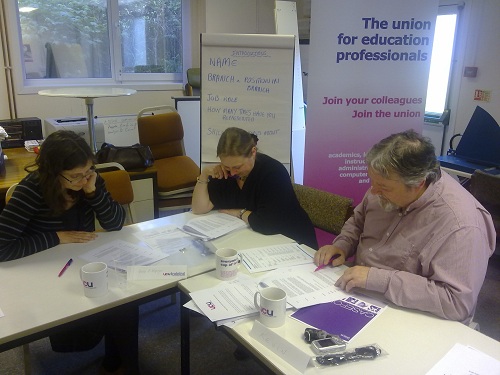
Eleven reps from across the UCU South West Region undergo an intensive, one-day training course at the Exeter UCU office. Here the course delegates role-play interviewing members in advance of representing them in meetings with an employer. All training for UCU reps is provided free and employers have a statutory duty to allow paid time off to attend.

16052013602


In this picture left to right Christina Ryan, City of Bath College, Linda Hinds, Petroc College, George Seba, Somerset College and Tony Wilde of City of Bath College.

16052013601


In this picture left to right Christina Ryan, City of Bath College, Linda Hinds, Petroc College,  Tony Wilde of City of Bath College and George Seba, Somerset College.
 16052013600


In this picture left to right Ulrike Zitzlsperger, University of Exeter, Emily Lygo University of Exeter and Kevin Thomas of City of Bristol College. 

16052013599


In this picture left to right Maria Donkin,  Maggie Hemsworth and  Chelo de Andres Martinez of Plymouth University and Sue Lea, UCP Marjon. 

If you think you could be a UCU rep, get in touch with UCU South West Regional Office exeter(at)ucu.org.uk or contact your branch’s secretary or chair. If you wish to take one of the many courses offered by UCU start here: http://www.ucu.org.uk/index.cfm?articleid=3311 to find courses, dates and times. 

Being a UCU activist: A brief intro to being a rep

The purpose of any trade union is to advance the interests of its members. Unions do this by negotiating collective agreements and by lobbying to improve laws that affect the membership.

UCU’s education programme offers its growing network of activists a wide range of courses. Courses are delivered on a regional basis so are therefore an ideal opportunity for members to learn from and network with reps from different branches within their region.

Check your regional listing in UCU training for further information

Whether you are an existing UCU activist or you are considering taking on a more active role within your UCU branch we have a course for you.

Unions also represent their members by seeing that employers do not violate their collective agreements or laws (health and safety, human rights, etc) that affect the members.  Colleges and universities sometimes want to have a free hand to provide services as cheaply as possible. This means that union members must work together to force employers to pay staff properly, to provide safe working conditions, provide us with job security, etc. Even in the worst of times unionised staff do better than those with no protection.

Being a rep is useful and highly rewarding work. What is more, you need not do this on top of your existing work.  Accredited unions reps are entitled to statutory, paid remission; are supported in their work by full-time officers and are entitled to free training and paid time off to do it. If you could be a rep in the South West contact us at: http://www.ucu.org.uk/index.cfm?articleid=2057&contactid=2221 or email me direct dotoole(at)ucu.org.uk.

UCU South West Region Facebook Page Launched

joinFBSW


UCU South West Region launches new Facebook Page. If you are a member of UCU or like the work that we do then “like” www.facebook.com/ucusouthwestregion.

120,000 of your colleagues and friends already DO.

Employment Rights Weakened… Again.

There have been a number of changes brought in by the coalition government recently which have served to weaken established employement rights. Last April changes were brought in to lengthen the period you must be employed to have the right not to be unfairly dismissed from one to two years. As many of you will know the government has again been busy making plans to change employment law. The changes come into effect on different dates, and some are unconfirmed as yet but on 6 April 2013 this change will take effect:

After 6 April there will be a reduction in the minimum consultation period where an employer proposes 100 or more redundancies at one establishment within 90 days. The minimum consultation period falls from 90 to 45 days. The change in the length of the consultation period means that you can be made redundant more quickly and talks with a union have less time to mitigate or avoid the consequences of the redundancy process.

So there has never been a better time or a more urgent need for employees to take advantage of the collective strength of a union.

If you want to find out more about UCU contact dotoole (at) ucu.org.uk